Mastering SQL: why SQL still matters and how to actually get good at it (1/10)
Why SQL still matters (and this will probably not change in the near future)
When searching for SQL on reddit what I most see about is that it's common place & easy to learn.
I actually agree with both these statements:
- SQL is easy to learn; but hard to master – even more so when you're working with it at scale with a tool like
dbtorSQL mesh, - It's the basis of Data work (I've worked with it at every company I've been)
Additionally and according to most articles I've seen online – SQL still goes strong and is listed as top 5 desirable data skillset.
 ExcelGoodies Consulting, Inc.
Tools like dbt or SQL mesh further reinforce the need for SQL work – most transformation you'll do there will be in SQL.
Finally, SQL is the universal language of Data – everybody in the Data fields works / has worked with SQL.
While it's true that some Data work may require a more specific expertise (Spark, Distributed compute etc.), I believe that 90 to 95% of companies do not actually need this kind of complexity as the business needs business value from data – not unneeded complexity around Data work.
As such, I believe that one one the best thing you can do for your Data career is to become excellent at the basics, like SQL.
How should one become SQL fluent ?
The dual path to mastery
This is the tricky part, to get really good at SQL, you actually have to both;
- Write good (readable, maintainable, performant) code,
- AND have an understanding on how things operate behind the hood.
For instance:
- How does the query compiler behind your Data Warehouse works behind the scene ?
- What are indexes ?
- What are window functions ?
- What are the key differences of the files you're using to store your data ?
- etc.
Just as Zach Wilson puts it, there are effectively 5 levels to SQL:
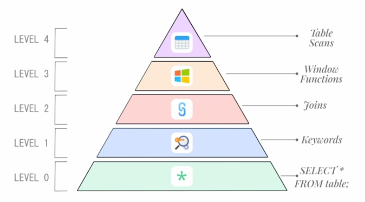
More often than not, to get to level 5, you'd need years of SQL work in the Data trenches.
Don't despair !
I've decided to distill everything I know about writing good SQL in this series of 10 articles to get you to level 5 – fast.
They will be divided as such [*]:
- 1. "Why SQL still matters and how to actually get good at it", this article,
- 2. "The 20% of SQL that will power 80% your work",
- 3. "Aggregates & Window functions: a powerful tool at your disposal",
- 4. "Advanced SQL patterns: deduplication, pivoting, retention calculation etc.",
- 5. "Writing readable, maintainable SQL",
- 6. "Writing typed data with SQL & DML",
- 7. "Working with indexes, partitions and clusters",
- 8. "File formats: why are they importants & how to use them effectively",
- 9. "Writing performant SQL & working with the query profile",
- 10. "Other SQL tips & tricks"
[*] (might come back to update this division at a later date)
Subscribe to the newsletter to receive each article as soon as they come out !

Struggling with your data analytics project? Let's fix it together.
I help teams solve tough data problems — fast.